Carry-On Only for 2 Weeks in Europe: 12 Tips That Actually Work
I almost abandoned my bag on the platform at Roma Termini. It was August 2025, 36°C, and I had exactly seven minutes to catch a train to Naples. The strap on my old duffel had finally torn, and the weight — barely 8 kg — felt like 20. That moment convinced me: carry-on only isn't just about avoiding checked-bag fees. It's about surviving the actual moving parts of a trip without wanting to cry. Two weeks across Italy and Croatia with nothing but a 40-liter backpack taught me that the standard packing lists are mostly fear-driven fluff. You don't need half of it. The rest is about choosing gear that works in the real world and building a system that holds up when you're sweaty, lost, or sprinting for a FlixBus.
Let's address the elephant in the overhead bin: yes, two weeks with a single carry-on is realistic. I've done it on three multi-country Europe trips now — summer in the Mediterranean, autumn in Central Europe, and an early-spring swing through the UK and Ireland. Each trip required a different variation of the same core list, but the principle held. The trick isn't magical minimalism. It's accepting that you will do laundry, you will wear things more than twice, and you will occasionally buy socks in a foreign pharmacy. Once you internalize that, the anxiety evaporates. European airlines, especially budget carriers like Ryanair and Wizz Air, have made checking a bag a costly gamble — not just in fees but in time. I've watched friends lose half a day waiting at carousels in Brussels and Barcelona. Meanwhile, I walked off the plane and straight onto a tram. This article is built from those trips: the mistakes, the workable hacks, and the one piece of advice I wish I'd ignored.
The Gear That Makes or Breaks Your Carry-On Strategy
Before you choose a single shirt, you need to choose the container. On my first attempt at carry-on-only, I used a stylish waxed-canvas weekender. It looked great in Instagram flat-lays. It was also heavy when empty, lacked a hip belt, and bulged so much under my seat on a Ryanair flight that the flight attendant made me gate-check it. That €70 fee stung more than the embarrassment. The right bag is unsexy and functional. Look for a backpack or hybrid duffel in the 35–45 liter range that opens like a clamshell — front-loading, not top-loading. You want to see everything at once, not dig through layers like an archaeologist. A padded hip belt is non-negotiable if you'll walk more than ten minutes with it on; your shoulders will thank you on a 20-minute trek from the train station to your Airbnb in Lisbon's Alfama district.
Airline size limits are a moving target. As of early 2026, most full-service carriers (Lufthansa, KLM, British Airways) allow overhead bags around 55 x 40 x 23 cm, but the budget carriers keep shifting the goalposts. Ryanair's standard fare now includes only a small personal item (40 x 20 x 25 cm) unless you pay for "Priority & 2 Cabin Bags," which permits a larger 55 x 40 x 20 cm bag. EasyJet's free under-seat allowance is 45 x 36 x 20 cm. I've learned to always check the specific airline's policy the week before flying because they do change. When I flew Transavia from Amsterdam to Nice last spring, the gate agent was checking every single bag with a steel sizer, and at least five people in line paid unexpected fees. My bag fit, but barely. Packing cubes are the piece of gear that makes the constant repacking tolerable. I use three: one for tops and dresses, one for bottoms and sleepwear, and a small one for underwear and socks. They compress soft items but, honestly, their real value is organization. When you're moving cities every three days, the ability to pull out one cube and know exactly where your clean shirt is saves sanity.
For toiletries, skip the elaborate "TSA-approved" kits with a dozen tiny bottles. Most European pharmacies sell excellent solid shampoo, conditioner, and soap bars that eliminate liquid limits entirely. I switched to a shampoo bar from a French brand after a leaky bottle ruined a silk blouse in my bag in Lyon. The bar lasted the whole trip and cost less than €5. For anything that must be liquid, I use 30 ml silicone squeeze tubes from Muji — they've never leaked on me across maybe 20 flights, though I still put them in a separate zip-top bag inside my toiletry pouch. The European 100 ml liquid rule per container still applies for carry-on, and you must fit all liquids into one transparent 1-liter bag at most security checkpoints. Lately, some airports (Amsterdam Schiphol, London City) have newer scanners that let you keep liquids in your bag, but I never count on this. I pack as if the old rules are in force, because at Malaga airport last June, they still were.
The Capsule Wardrobe Formula: 12 Items That Create 30+ Outfits
"Capsule wardrobe" can sound like a Pinterest fantasy, but on a trip it's a survival mechanism. My formula after several trips is not about a specific brand list; it's about a decision framework. I pack by color family: for me, that's black, charcoal, navy, and one accent color (usually rust or olive). Everything matches everything else. The actual count hovers around 12–14 pieces, including what I wear on the plane. On that Italy-Croatia trip, my list was: 1 pair of black technical-fabric trousers, 1 pair of dark jeans (worn on travel days), 1 lightweight linen-blend dress, 3 merino-blend T-shirts, 1 long-sleeve linen button-up, 1 thin merino cardigan, 1 packable rain jacket, 1 swimsuit, 5 pairs of underwear, 3 pairs of merino socks, and 1 pair of black leather sneakers. That's it. With layering, it covered 14 days, including a nice-ish dinner in Split and a sudden downpour in Bologna.
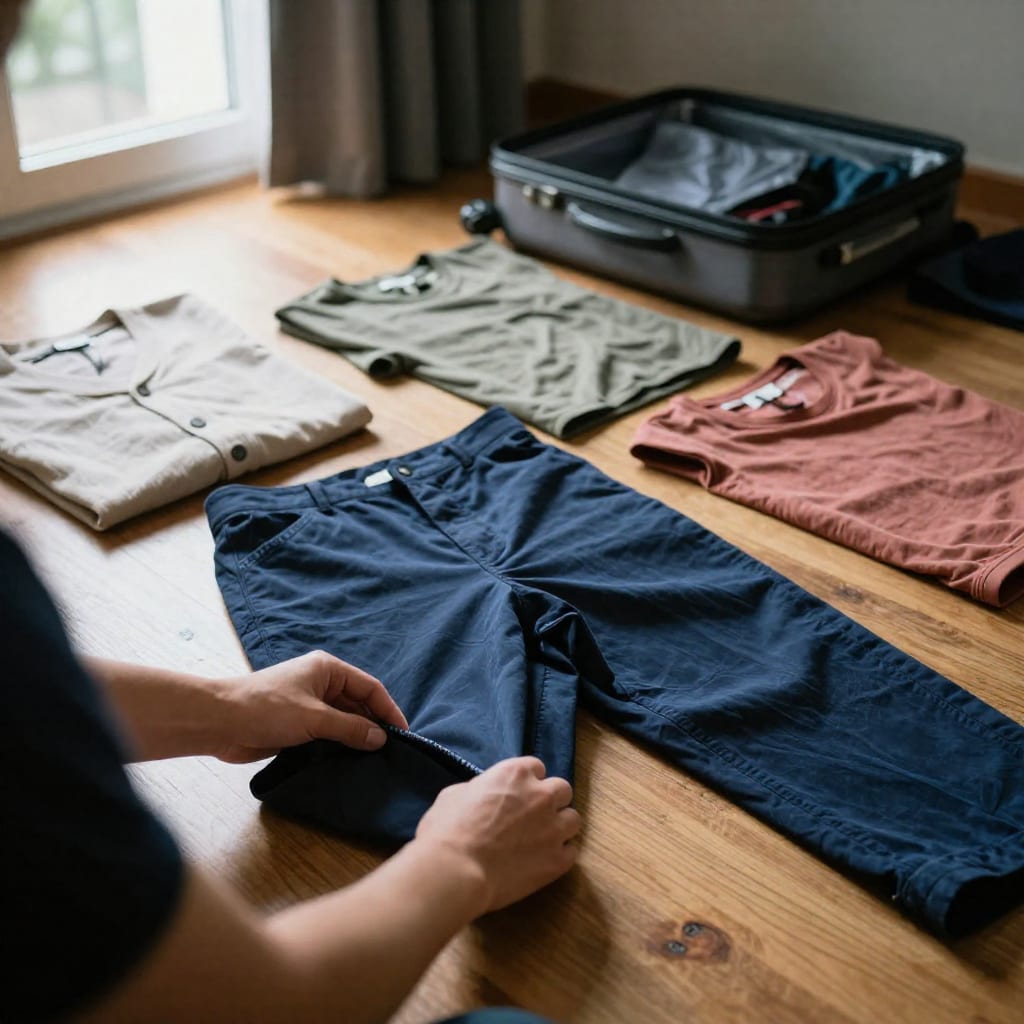
The fabric choices do the heavy lifting. Merino wool resists odor for multiple wears — I've worn the same T-shirt for three days of walking in Rome in August and it didn't smell, which sounds like an ad but is genuinely true. It dries quickly after a sink wash, usually overnight. Linen wrinkles but breathes; in high heat, that's worth the trade-off. Technical trousers (like those from athleisure brands) can pass as slacks, dry fast, and pack small. The one thing I now skip: a "going-out" outfit that doesn't also work for day. I used to pack a silk camisole and heels. I wore each exactly once, on different trips, and both times felt overdressed and uncomfortable on cobblestones. Now I bring one pair of simple leather sneakers that work with trousers and the dress, and if I need to look fancier, I add a bold lipstick and statement earrings that take up less space than a pack of gum.
Laundry is the linchpin. I do a quick sink wash every two to three days. My method: fill the bathroom sink with warm water, add a few drops of travel detergent (I like the concentrated sheets — they weigh nothing), agitate the clothes for a minute, then let them soak while I shower. Rinse, roll in a towel to squeeze out water, and hang. In humid places like coastal Croatia, drying can take longer than you think, so I avoid washing jeans on those days. I've also used local laundromats twice: once in Berlin, where a €4 wash-and-dry took 90 minutes at a spot with good coffee next door, and once in Edinburgh, where a "service wash" at a launderette cost £12 and was ready in four hours. Both were cheaper and less hassle than overpacking. The key is to plan a laundry window into your itinerary — usually on a slower morning or a transit afternoon. If your accommodation doesn't list a washing machine, assume you'll do sink washes or scout a laundromat in advance; most European cities have them, but rural villages might not.
Real-World Packing Hacks That Save Space and Stress
The classic "roll, don't fold" debate is settled, but with nuance. Rolling soft garments like T-shirts and dresses does reduce wrinkles and lets you see more in a packing cube. But for structured items like button-up shirts, I fold them using the bundle method — wrapping them around a central core of socks and underwear to avoid hard creases. It sounds fussy, but when I pulled out my linen shirt in Vienna after five days in a bag, it looked fine enough to wear to a museum without ironing. Shoes are the real space thieves. I wear my bulkiest pair on the plane — always — and pack the smaller pair (if I bring a second) stuffed with socks, chargers, and a belt. That's a trick I learned from a flight attendant on a delayed EasyJet flight, and it genuinely works. I also use the inside of my rain jacket's pockets to store a compact umbrella and a packable tote bag; once on board, the tote becomes my in-flight personal item, and the jacket gets stowed overhead.
One habit that saves more space than you'd think: decant everything. I mean everything. Hotel-size toiletries get squeezed into my own tiny bottles. Snacks come out of bulky packaging and into a zip-top bag. My travel first-aid kit is six ibuprofen, four antihistamines, and two plasters in an old mint tin. All the "just in case" bulk disappears. I also carry a single, large cotton scarf that doubles as a plane blanket, a beach cover-up, and a wrap for visiting churches with covered-shoulder rules. That scarf has probably been my most-used item across three continents. A caveat: these space-saving tricks work best for solo travelers or couples who can share a bag's load. If you're packing for small children or require specialized gear (like CPAP machines or bulky medical supplies), the calculus changes, and some of these hacks will feel inadequate.
Surviving Airport Security and Budget Airlines Without Checking a Bag
Security lines in Europe are inconsistent. At Zurich, I've breezed through with liquids still in my bag thanks to new CT scanners. At Naples, the same week, I had to unpack my entire toiletry kit because the agent didn't like the look of my solid shampoo bar (she eventually waved it through). My rule now: always pack liquids and electronics in the most accessible spot, usually the top pocket or a front compartment, so you can pull them out in seconds. I keep my 1-liter liquids bag and a separate pouch for my laptop and charger in the same place every trip. When the person behind me in line is sighing, that consistency saves me fumbling.
Budget airlines are the real test. Ryanair, Wizz Air, EasyJet, and Vueling have all tightened their gate enforcement. On a Wizz Air flight from Budapest to Milan, the gate agent weighed my bag — it was 9.8 kg, and their limit was 10 kg. I got lucky. Now, I use a handheld luggage scale (the size of a keychain) and check my bag's weight the night before every budget flight. If it's over, I layer up: wear the heavy cardigan, stuff the jacket pockets with my power bank and a book, and sometimes carry my toiletry bag in my hand. This is not a reliable loophole — some gate agents will count anything you're holding as part of your allowance, and I've seen passengers forced to consolidate or pay. On a recent EasyJet flight from London Gatwick, a staff member explicitly told a woman that her neck pillow counted as an extra item. I no longer recommend trying to game the system with a travel pillow stuffed with clothes; it works sometimes, fails other times, and the stress isn't worth it. Pay for the priority boarding if your bag is close to the limit, or pack light enough that you're never at the margin.
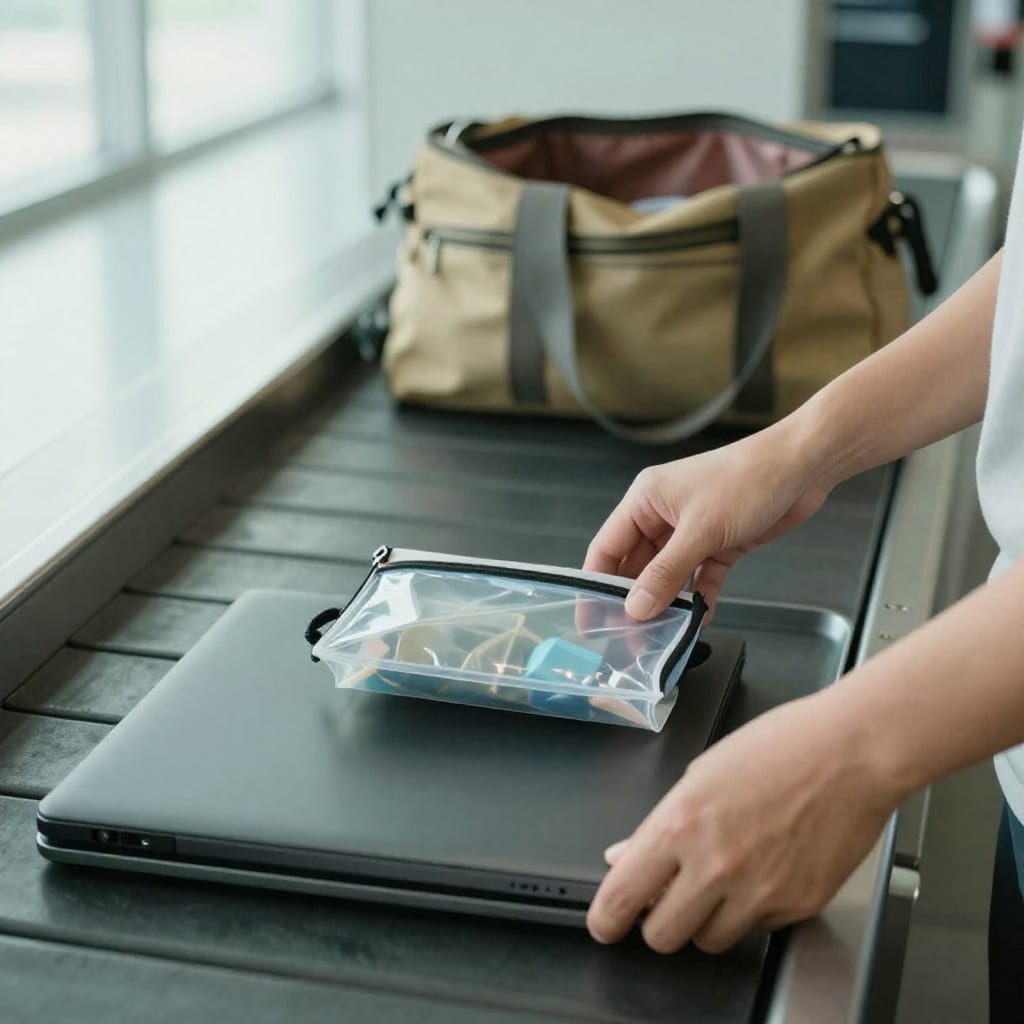
Gate-checking is a constant low-level threat. On smaller regional jets or packed flights, the overhead bins fill up. I've had my bag gate-checked twice: once on a Lufthansa CityLine flight to Florence, and once on an Air France hop from Paris to Bordeaux. Both times, I had a small crossbody bag with my passport, phone, charger, earbuds, a change of underwear, and my medication. That crossbody is my lifeline. If my main bag disappears into the hold, I can survive a day or two. It's a habit I started after a friend's carry-on was gate-checked on a flight to Sicily and lost for four days. She spent the first two days of her trip buying basics at an H&M in Palermo. I'd rather not.
What to Do When You Need Something You Didn't Pack
It will happen. On a trip to Scotland in October 2024, I packed for typical autumn weather and arrived to find an unseasonal cold snap with sleet. I didn't have a proper coat. In Edinburgh, I walked into a charity shop on Nicholson Street and bought a vintage wool overcoat for £18. I wore it for five days, then donated it back before flying home. That coat is now a fond memory, not a packing failure. Europe is full of shops. If you need a warmer layer, an umbrella, a dress for a last-minute dinner, or a phone charger, you can buy it — often for less than the cost of a checked bag. Pharmacy chains like Boots (UK), DM (Germany/Central Europe), and Parapharmacies (France) are everywhere and sell quality travel-sized everything. I've bought sunscreen, cold medicine, and a surprisingly good €4 eyeliner in a pinch.
The real insight here is psychological: you are not leaving civilization. Packing fear often comes from an imagined scenario where you're stranded without resources. The reality is that you're moving between cities with robust retail infrastructure. The one exception I've encountered was on a remote island in Greece where the nearest shop was a 40-minute bus ride away. In that case, I borrowed a sweater from my travel companion. If you're going significantly off-grid — hiking the West Highland Way, staying in a rural agriturismo — adjust the strategy. For most city-to-city Europe trips, you can pack for the median scenario and buy your way out of the outliers.
How to Keep Your Carry-On Organized During the Trip
Multi-city travel kills organization. By day four, my bag used to look like a fabric grenade had exploded. Now I follow a simple rule: nothing loose. Every item lives in a specific cube or pouch, and the pouch goes back in the same spot every time. I use a small, bright-colored stuff sack for dirty laundry so it never mixes with clean clothes. When I arrive at a new hotel, I unpack the cubes onto the open shelves or into drawers — never leave things in the bag. That five-minute ritual prevents the slow creep of chaos. I also use a hanging toiletry bag with a hook; it stays off the bathroom counter and contains any spills.
Hotel amenities can lighten your load. Most European hotels, even budget ones, provide soap and shampoo. I've stopped packing shampoo entirely when I know I'll be in hotels rather than hostels, and I use the provided stuff. The quality is often fine, and if it's not, I buy a local alternative. One habit I've adopted: I keep a running note on my phone of what I actually used on each trip. After three trips, the list is remarkably consistent. The things I never used — a travel clothesline, a sink stopper, a "just in case" dressy top — are crossed off forever. That note is my honest packing list, refined by evidence, not anxiety.
Who This Method Does Not Work For (Without Adjustments)
I want to be clear about the limits. If you're traveling for business and need a full suit, dress shoes, and a pressed shirt every day, a single carry-on is punishing. You can do it with careful folding and fabric choices (wool suits travel better than you'd think), but it requires a level of fuss that might not be worth it. If you're traveling with infants or toddlers, the sheer volume of nappies, wipes, and changes of clothes makes a carry-on-only strategy extremely difficult; I'd look at one checked bag for the family and keep essentials in carry-ons. If your trip is exclusively winter in far-northern Europe — think Finland in February — the bulk of a proper parka and boots makes a carry-on a tight squeeze. In that case, I'd still aim for a carry-on but accept that I'll be wearing my heaviest gear and possibly checking a bag with shared group items. This advice is built for the typical two-week, multi-city, spring-to-autumn Europe trip that most people take. It works brilliantly for that. Outside those parameters, adapt ruthlessly.
The biggest takeaway from my own trips is that carry-on-only travel is a skill, not a deprivation. It gets easier each time. The first attempt, I overpacked and paid a fee. The second, I forgot a crucial charger. By the third, I walked onto a plane with a bag that weighed 7.5 kg, had everything I needed for 16 days, and felt genuinely free. Worth bookmarking before your next Europe trip — the packing list in your head is almost certainly heavier than the one you'll actually use.